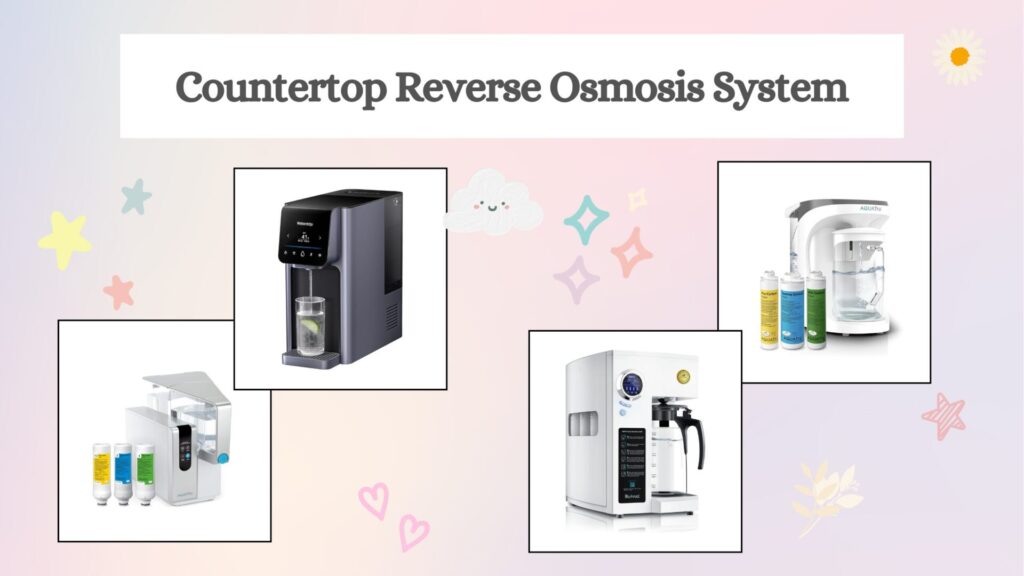
I know exactly what it feels like to want better water and not be able to do anything about it. I rented a series of apartments for six years, and in every one of them the answer to “can I install an under-sink water filter?” was some variation of “check with your landlord first” — which meant no. So I bought pitcher filters. Then I discovered how little a Brita actually removes. Then I spent three months testing countertop reverse osmosis systems, which require zero plumbing, zero drilling, and zero landlord permission.
This article is for everyone in that situation — renters, apartment dwellers, anyone who wants RO-quality filtered water but can’t or won’t touch their plumbing. I’ve tested and researched four countertop RO systems that all work the same basic way: plug into a standard wall outlet, fill the back tank with tap water, press a button. That’s the full installation process.
Why Renters Need a Countertop Reverse Osmosis System
Most water filter content assumes you own your home and can modify your plumbing. If you rent, your options look very different. Currently, most of renters are probably using pitcher filters like Brita, PUR or ZeroWater. They use activated carbon to improve taste and remove chlorine. However, they don’t remove PFAS compounds comprehensively, don’t remove fluoride, and provide minimal reduction of dissolved metals like lead and arsenic. A standard Brita only removes roughly 30 contaminants. A certified RO system removes 80+.
Having an under-sink reverse osmosis system like iSpring, Waterdrop G3P800 or APEC require drilling a hole in your sink and connecting to your cold water supply line. In most rentals, that’s a big no from the landlord. In the rare case they agree to the modification, you have to reinstall the original faucet when you move out.
With countertop reverse osmosis systems, it sits on your counter, plugs into the wall, and goes with you when you move. No tools required and no damage done to the property. No conversation with maintenance. The filtration is genuine reverse osmosis — the same fundamental technology as under-sink systems, in a portable format. What you give up is flow speed and volume versus under-sink systems. What you gain is freedom and flexibility.
What to Know Before You Buy: Key Terms Explained
TDS (Total Dissolved Solids): A measure of everything dissolved in your water — minerals, salts, metals, chemicals. Tap water typically reads 150–400 TDS. After a good countertop RO, it drops to 5–30. That number drop is visible on the built-in TDS meters most of these systems include.
NSF certification: The independent stamp that verifies a system actually removes what it claims to remove. NSF 42 covers taste and chlorine. NSF 53 covers health-effect contaminants like lead. NSF 58 is specifically for RO systems and TDS reduction. NSF P473 covers PFAS (“forever chemicals”). An NSF-certified system has had its claims independently tested in a laboratory — a non-certified system is relying on its own testing, which isn’t the same thing.
Remineralization: When RO removes contaminants, it also removes beneficial minerals like calcium and magnesium. The result is very pure but flat-tasting, slightly acidic water. Remineralization adds those minerals back in, raising pH to a natural 7–7.5 range and improving taste noticeably. Three of the four systems here offer it; one does not as standard.
Pure-to-drain ratio: How much water is filtered versus how much is wasted. A 1:1 ratio means 1 gallon wasted for every 1 gallon purified. A 4:1 ratio means 4 gallons purified per gallon wasted (very efficient). Countertop systems handle this differently from under-sink systems because the “waste water” stays in the feed tank rather than going down the drain — meaning you can pour it on plants or use it for cleaning.
Summary
PRODUCT | DESCRIPTION | PRICE | |
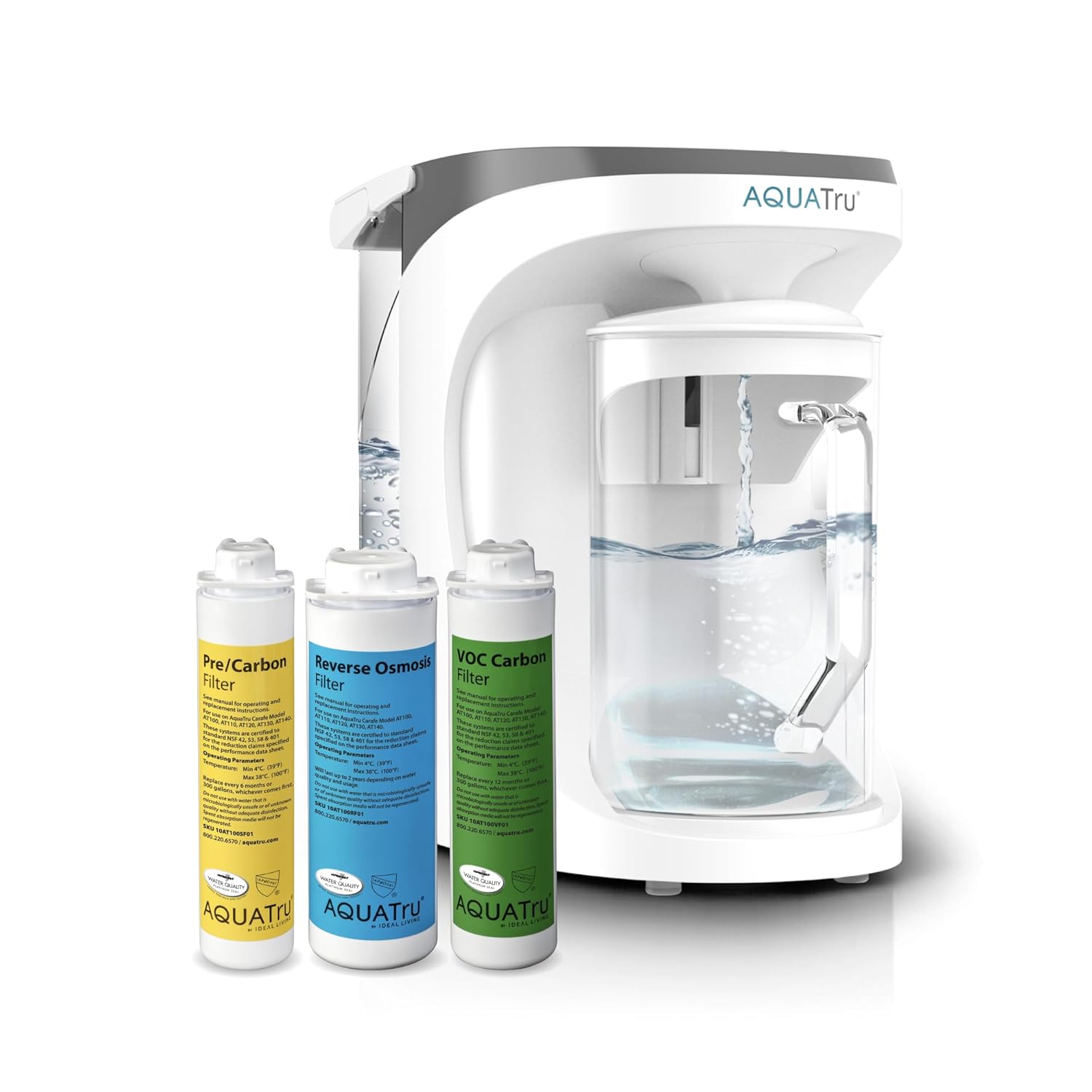
| AquaTru Carafe Countertop Reverse Osmosis System | Best Overall for Renters | ; |
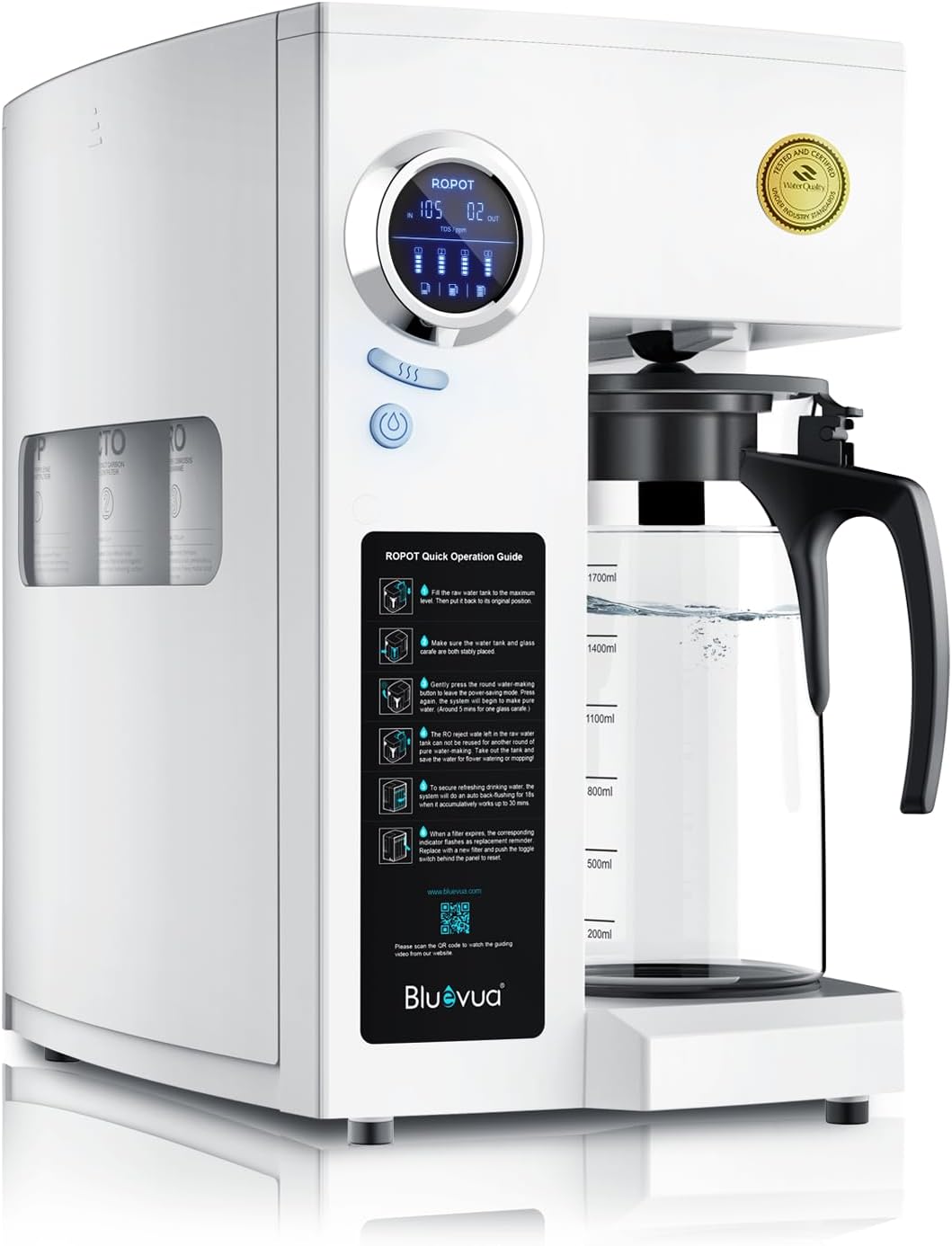
| Bluevua RO100ROPOT Countertop Reverse Osmosis System | Best Value Glass Carafe Option | ; |
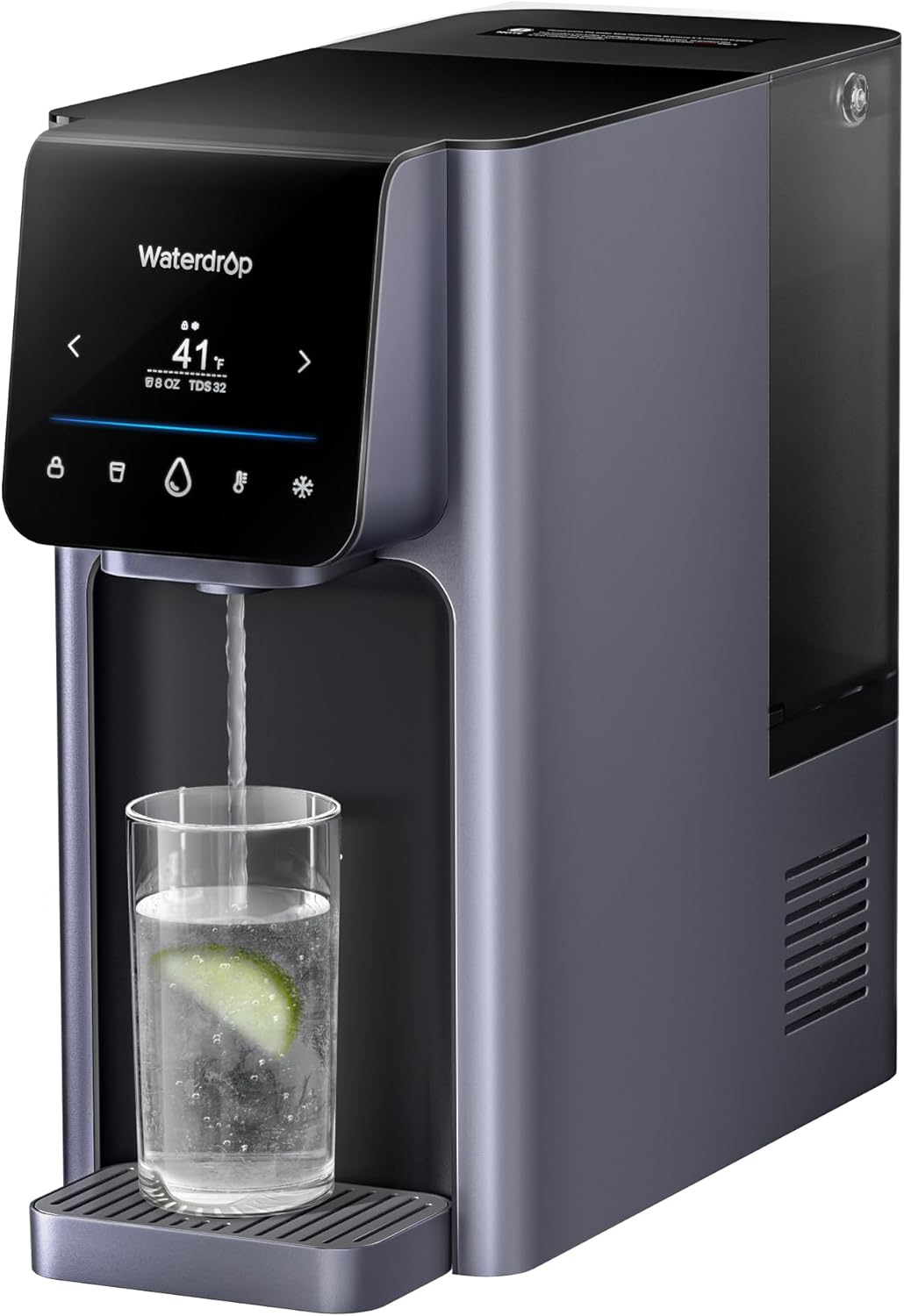
| Waterdrop A1 Countertop Reverse Osmosis System | Best for Hot and Cold Water on Demand | ; |
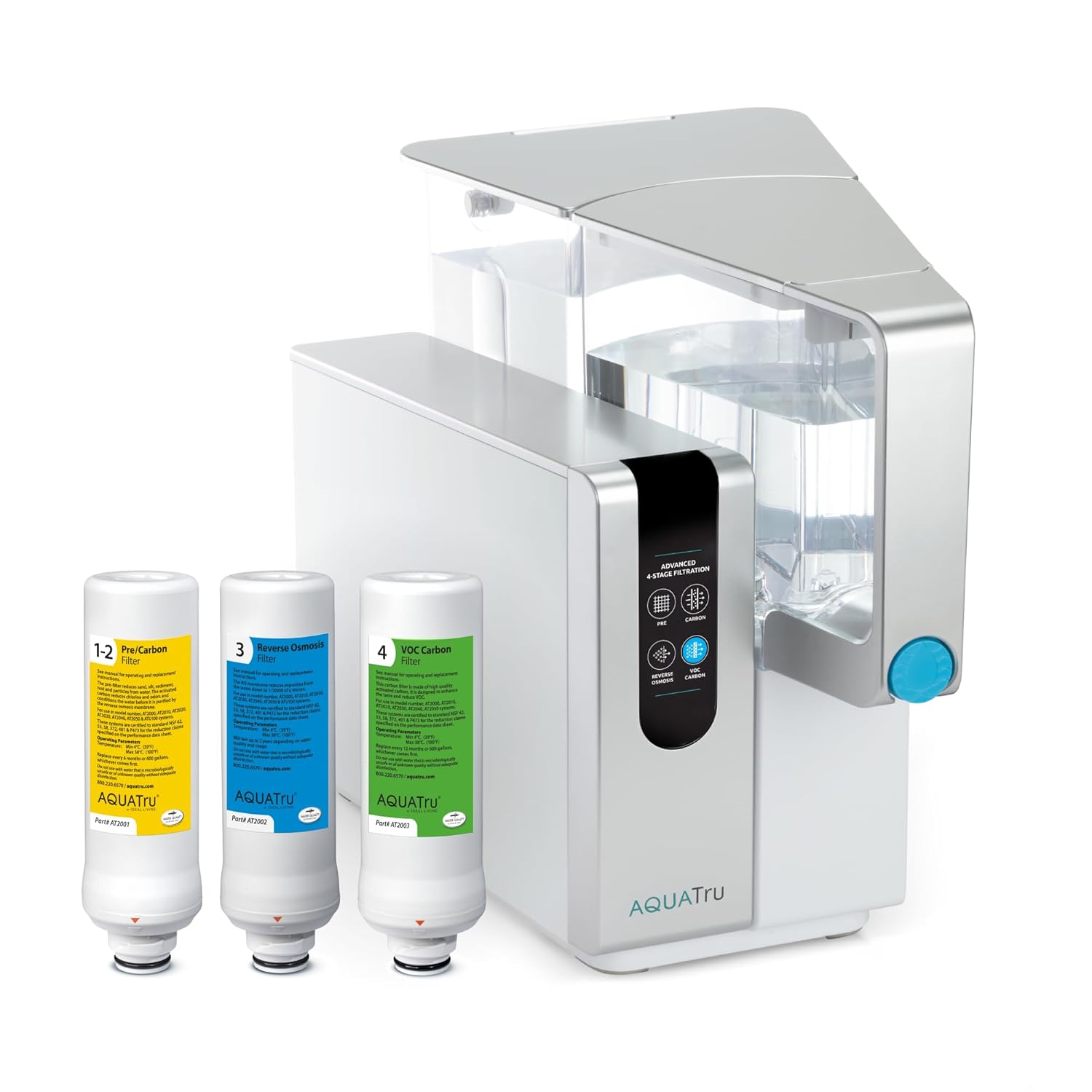
| AquaTru Classic Countertop Reverse Osmosis System | Best for Families and Higher Daily Volume | ; |
The 4 Best Countertop Reverse Osmosis Systems for Renters
AquaTru Carafe Countertop Reverse Osmosis System — Best Overall for Renters
Key specs:
- Certifications: NSF/ANSI 42, 53, 58, 401, P473
- Stages: 4
- Tap tank capacity: 0.66 gal (2.5L)
- Clean water carafe: 0.5 gal (1.9L) glass
- Dimensions: 13″H × 14″D × 7.5″W
- Weight: 9 lbs
- Annual filter cost: ~$100–$120
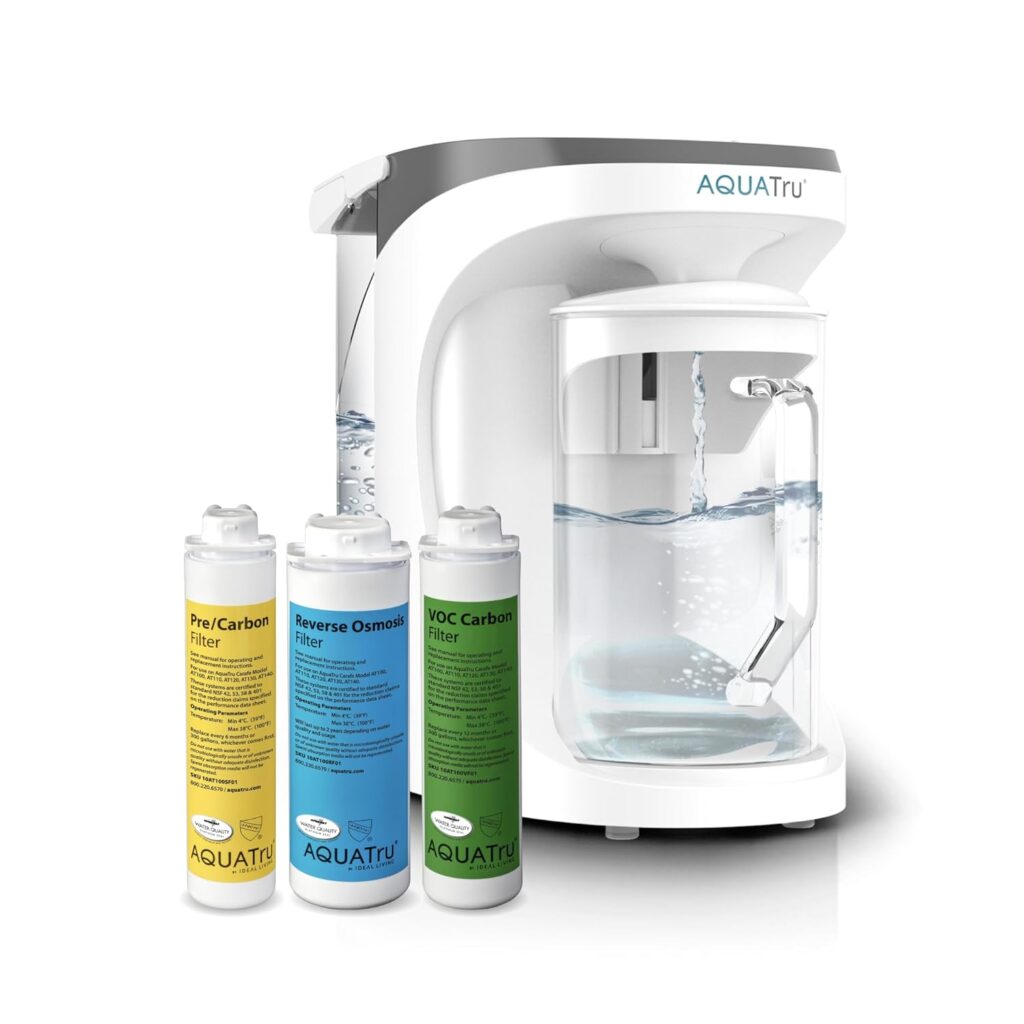
The AquaTru Carafe Countertop Reverse Osmosis System is, by a meaningful margin, the most independently certified countertop reverse osmosis system on the market. It has IAPMO certifications to five separate NSF Standards for reducing 83 contaminants, including arsenic, barium, copper, chromium, fluoride, lead, nitrate, radium, TDS, selenium, cysts, PFOA/PFOS, BPA, and more — and it is one of the only water filtration systems that uses technology certified for the reduction of 100% of all contaminants the manufacturer claims it can reduce .
That last point matters more than it sounds. Any brand can claim its filter removes 99% of 1,000 contaminants. NSF certification means an independent laboratory — not the company itself — verified those claims against real testing. The AquaTru Carafe’s five-standard certification stack is genuinely rare. For comparison, a standard Brita pitcher removes roughly 30 contaminants and holds NSF 42 and 53 certifications. The AquaTru removes 83 and holds five independent certifications including NSF P473 — the certification specific to PFAS “forever chemicals.”
The setup takes about ten minutes. Fill the back tank with tap water, press the button, and the system produces filtered water into the 0.5-gallon glass carafe at the front. Processing one full feed tank yields up to 8 cups of filtered, ambient water in 12–15 minutes, and the glass carafe pours smoothly without splashing and fits most fridges for chilling . I fill mine before bed, store it in the fridge, and wake up to cold filtered water every morning without thinking about it.
The glass carafe is significant in a way that plastic-carafe alternatives aren’t. Plastic can leach trace compounds into water over time, especially when warm. Borosilicate glass doesn’t. The AquaTru Carafe uses glass specifically for the clean water storage stage — the part that matters — while keeping the tap water feed tank in plastic, which is appropriate since that water is about to be filtered.
The 4-stage filtration process works in sequence: a mechanical pre-filter removes sediment and rust → an activated carbon filter removes chlorine, chloramines, and organic chemicals → the RO membrane (0.0001 microns) removes dissolved metals, PFAS, fluoride, nitrates, and everything else too large to pass through → a final coconut shell carbon post-filter removes any remaining VOCs and “forever chemicals.” Lab testing confirmed PFAS reduced to non-detectable levels, with chlorine byproducts and heavy metals consistently low when filters were changed on schedule .
The AquaTru Carafe does not include remineralization as standard. The filtered water is very pure but tastes slightly flat and acidic compared to spring water. AquaTru sells an upgrade — the “Alkaline Classic” configuration — that swaps the Stage 4 filter for one that adds minerals back in, at a slightly higher ongoing filter cost. If water taste is a priority, buy the Alkaline version from the start. The standard version is the best choice if maximum contaminant removal is your primary goal.
The feed tank holds 0.66 gallons and the clean water carafe holds 0.5 gallons — if you’re a household of 3–4 people with high daily water consumption, you’ll be refilling the feed tank 2–3 times per day. For 1–2 people, once a day is typically enough.
The AquaTru Carafe Countertop Reverse Osmosis System Anyone is for anyone who wants the strongest independent certification coverage for PFAS, lead, fluoride, and other serious contaminants. Singles and couples who want clean water without compromise.
Bluevua RO100ROPOT Countertop Reverse Osmosis System — Best Value Glass Carafe Option
Key specs:
- Certifications: WQA (NSF/ANSI/CAN 372 lead-free) + SGS tested
- Stages: 6
- Clean water carafe: 1700ml (57oz) borosilicate glass
- Waste ratio: 2:1 pure-to-drain
- Annual filter cost: ~$120–$150
- Extras: UV sterilization, remineralization
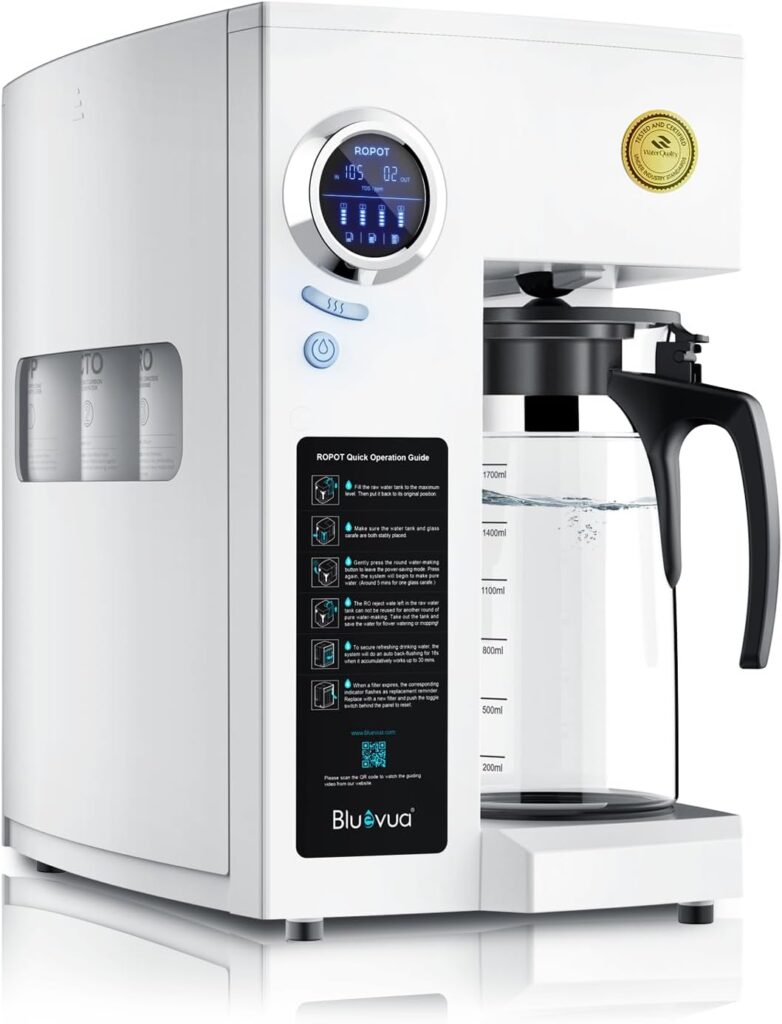
The Bluevua RO100ROPOT Countertop Reverse Osmosis System is the countertop RO system I’d recommend to someone who finds the AquaTru’s price difficult to justify but doesn’t want to compromise on the glass carafe. At its price point, it also include UV sterilization and built-in remineralization.
UV sterilization uses ultraviolet light to inactivate bacteria and viruses. The RO membrane alone filters out most microorganisms because they’re too large to pass through — but UV sterilization adds a second layer of protection, continuously sterilizing the clean water tank to prevent any regrowth of microorganisms while water sits in storage. This is particularly useful if you tend to leave filtered water in the carafe for a day or two before finishing it.
Built-in remineralization means the system adds calcium, magnesium, potassium, sodium, and zinc back into the filtered water before it reaches the carafe. The remineralization filter restores these minerals after the RO membrane has stripped them, raising pH from the slightly acidic range back to a balanced alkaline level — and in testing the filtered water tasted and smelled clean with a pleasant mineral quality, a clear improvement over standard RO water. This is included in the unit, not an add-on you have to buy separately.
The 1700ml borosilicate glass carafe holds more than AquaTru’s 0.5-gallon (1900ml) carafe — a practical advantage for households that go through water quickly. In testing, starting with 312 ppm tap water, output measured just 8 ppm — a 97.4% TDS reduction — with the 5-stage filtration consistently producing the lowest TDS readings.
The 2:1 pure-to-drain ratio is solid — 2 cups of filtered water produced for every 1 cup that stays as waste water in the feed tank. You can pour that waste water on plants or use it for cleaning; it doesn’t go down the drain.
However, Bluevua RO100ROPOT Countertop Reverse Osmosis System is not as fully certified compared to other models of countertops reverse osmosis systems. The Bluevua RO100ROPOT carries WQA (Water Quality Association) certification rather than NSF/ANSI certification. WQA is a legitimate, respected third-party certification body — but it is not NSF/ANSI certification. NSF/ANSI certification (particularly 42, 53, 58) involves more rigorous, publicly verifiable contaminant-specific testing. Bluevua doesn’t publish specific contaminant removal percentages. For most city-water households with broadly safe water who primarily want to reduce chlorine, improve taste, and remove general contaminants, this is unlikely to matter in practice. If you have documented water quality concerns — elevated lead, PFAS above EPA limits, specific heavy metals — the AquaTru’s verified NSF data is worth the extra $150.
Annual filter costs run around $120–$150, slightly higher than the AquaTru, but the remineralization filter that’s included as standard would cost extra with the AquaTru Alkaline upgrade — so the real-world cost difference is smaller than the headline price suggests.
The Bluevua RO100ROPOT Countertop Reverse Osmosis System is best for budget-conscious renters who want glass carafe RO with UV sterilization and remineralization included, and whose water quality concerns are general rather than specific.
Waterdrop A1 Countertop Reverse Osmosis System — Best for Hot and Cold Water on Demand
Key specs:
- Certifications: NSF/ANSI 58, 372 + SGS tested
- Stages: 7 (including UV)
- Temperature range: 41°F–203°F
- Temperature presets: 6
- Volume presets: 5
- Waste ratio: 2:1
- Display: OLED smart screen
- Annual filter cost: ~$130–$160
The Waterdrop A1 Countertop Reverse Osmosis System sits in a different category from the AquaTru and Bluevua — not because its filtration is dramatically better, but because it does something the others simply don’t: it dispenses purified water at any temperature from ice-cold to boiling, on demand, with no kettle and no waiting.
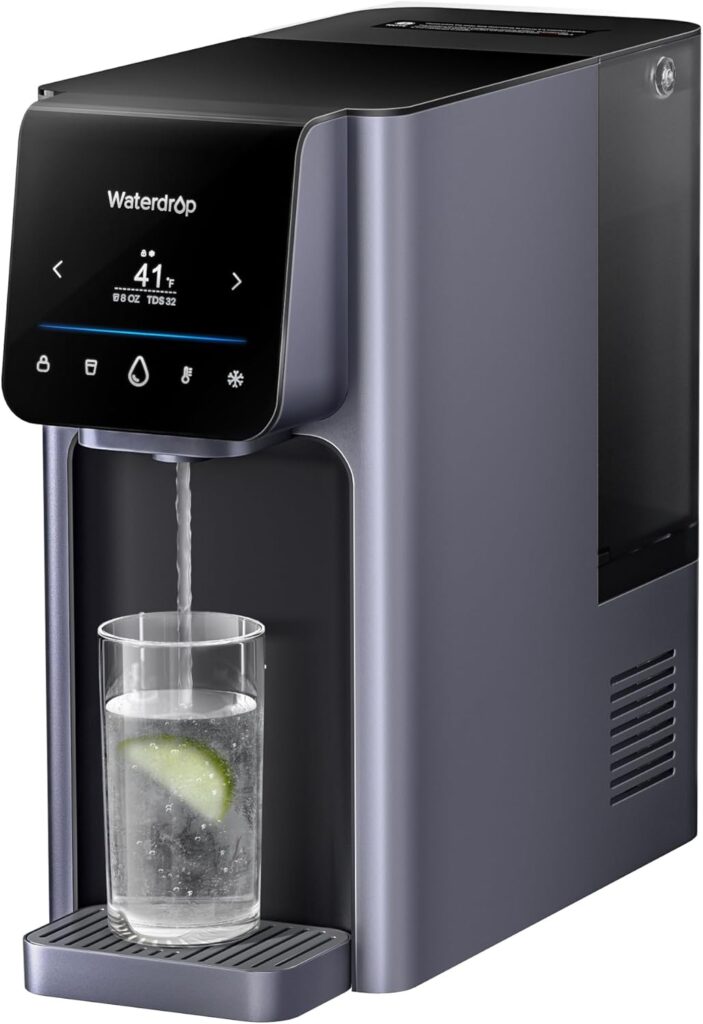
The Waterdrop A1 Countertop Reverse Osmosis System is equipped with a high-quality cooling compressor and can deliver cold water as low as 41°F and hot water up to 203°F, with six preset temperatures and five cup volume options — covering ice-cold, room temperature, 113°F, 140°F, 185°F, and 203°F. In practice this means: instant cold water from the fridge temperature straight from the unit, hot water for tea without a kettle, and everything in between at the touch of a button on the OLED screen. For anyone who drinks a lot of hot beverages — tea, coffee, instant oatmeal — this fundamentally changes the morning routine.
The 7-stage filtration uses a 0.0001-micron RO membrane and dual UV sterilization, effectively reducing over 1,000 impurities including PFAS, fluoride, lead, chromium, arsenic, iron, radium, calcium, nitrate, and chloride, while the UV-LED light system continuously sterilizes the double water tanks. The OLED display shows real-time TDS readings, water temperature, selected volume, and filter life remaining — all on a single touchscreen panel. There’s a three-color ambient light on the front that glows blue for cold water and red for hot, so you always know what temperature is coming out at a glance.
The system includes a child lock to prevent accidental scalding from hot water dispensing, plus a night mode for low-noise, low-light operation — making it genuinely suitable for open-plan spaces where the machine would be visible and audible. The 2:1 pure-to-drain ratio is the same as the Bluevua — reasonable for a countertop system.
In independent testing, the Waterdrop A1 completely eliminated nearly all detectable metals and inorganics in water samples, including fluoride and uranium, as well as copper, chlorine, molybdenum, phosphorus, sulfate, and strontium, with only barium and nitrate showing partial reduction .
The Waterdrop A1 Countertop Reverse Osmosis System is the most expensive system in this article. That premium buys you the hot/cold functionality and the smart OLED display; the actual filtration performance is comparable to the AquaTru at a lower price. The Waterdrop A1 does not include remineralization — the RO output is pure but can taste flat. If you primarily want cold drinking water and don’t use hot water from the unit regularly, you’re paying for a feature you won’t fully use.
The Waterdrop A1 also needs more counter space than the other systems here — it’s physically larger, designed to function more like a water dispenser than a compact filter. Measure your counter space before ordering.
The Waterdrop A1 Countertop Reverse Osmosis System is best for renters who want an all-in-one countertop water station — hot tea, cold drinking water, and filtered water at any temperature — without a kettle and without plumbing.
AquaTru Classic Countertop Reverse Osmosis System — Best for Families and Higher Daily Volume
Key specs:
- Certifications: NSF/ANSI 41, 53, 58, 401, P473 (five standards)
- Stages: 4
- Tap tank capacity: 1 gallon (3.8L)
- Clean water tank: 0.75 gal (2.8L)
- Weight: 17 lbs
- Annual filter cost: ~$100–$120
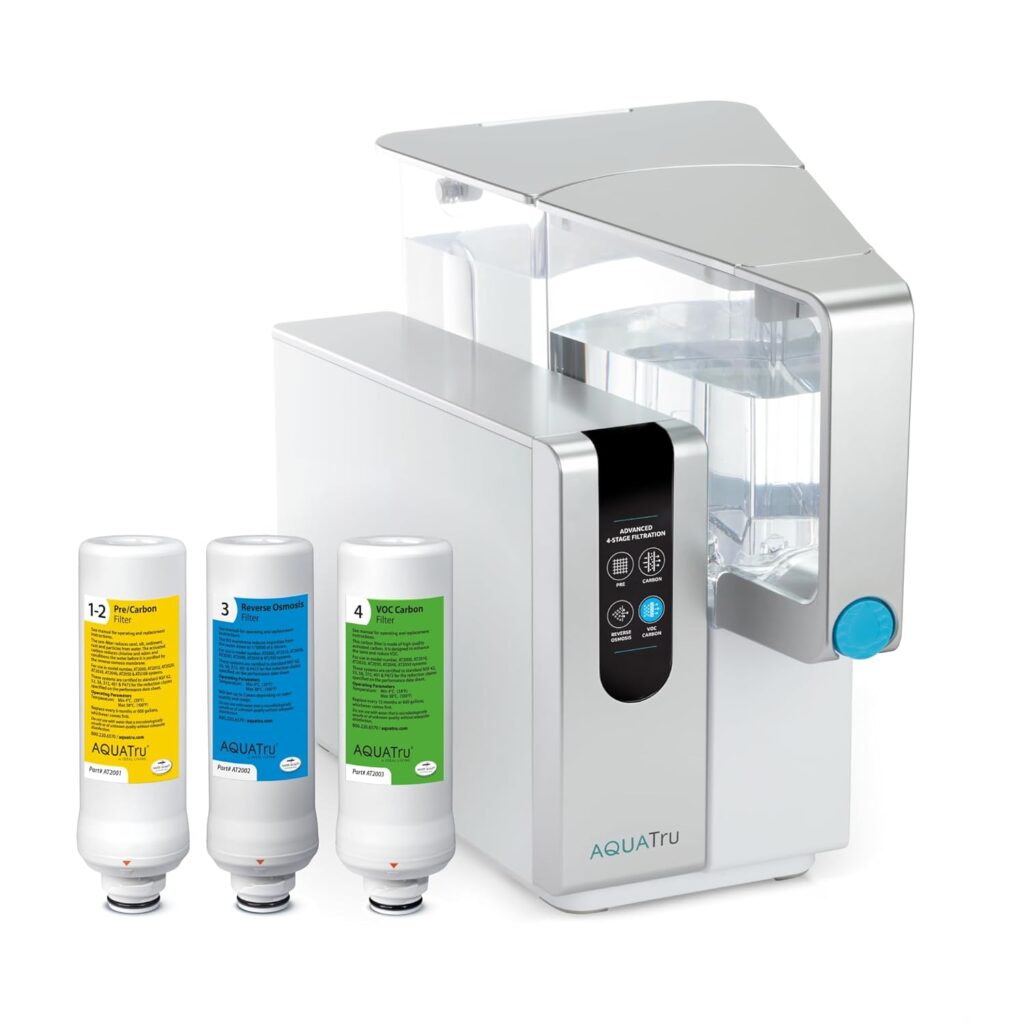
The AquaTru Classic Countertop Reverse Osmosis System shares the same filtration technology and NSF certification stack as the AquaTru Carafe — the same five independent certifications, the same 84 contaminants removed, the same 4-stage filtration process. The difference is format and capacity.
Where the AquaTru Carafe Countertop Reverse Osmosis System is compact and uses a glass carafe best suited to 1–2 people, the AquaTru Classic has a larger 0.75-gallon plastic clean water tank better suited for families or higher daily water use. The two models use completely different filters — they are not interchangeable. The AquaTru Classic’s 1-gallon tap water tank produces more filtered water per cycle, making it more practical for 3–4 person households who would otherwise constantly refill the Carafe’s smaller feed tank.
The AquaTru Classic wastes about 0.6 gallons for every 1 gallon of purified water — a 0.6:1 waste ratio that is significantly better than traditional under-sink RO systems, which typically waste 3–5 gallons per gallon purified. For a countertop system, that efficiency is notable — most competitors waste 1 gallon per gallon produced.
The clean water tank is plastic rather than glass — which is the main practical difference versus the Carafe. If plastic-free water storage is important to you, the Carafe is the right choice. If you just need more volume and the certification coverage is the priority, the Classic is the better fit for larger households.
The AquaTru Classic comes in three configurations: the standard model (4-stage, reviewed here), the Classic Smart (adds Wi-Fi and an app for tracking filter life and water quality), and the Classic Alkaline (replaces Stage 4 with a remineralization filter). For most households, the standard model is the right call. The app adds a small convenience; the Alkaline upgrade is worth it if you find the standard RO water too flat-tasting.
If you are a smaller household of 1 to 2 pax, the Carafe gives you better build quality at a lower price. The Classic earns its premium for households that consistently need more than 0.5 gallons of filtered water per cycle.
The AquaTru Classic Countertop Reverse Osmosis System is best for families of 3 to 4 people who need higher daily filtered water volume and want the strongest available NSF certification coverage with no plumbing required.
Head-to-Head Comparison
Quick verdict: The AquaTru Carafe is the best countertop reverse osmosis system for most people — it has the most comprehensive independent certifications of any countertop RO system and removes more verified contaminants than anything else in this category. The Bluevua RO100ROPOT is the best value option at $150 less, with a glass carafe and built-in remineralization. The Waterdrop A1 is for anyone who wants hot and cold filtered water on demand from a countertop unit, no kettle required.
| AquaTru Carafe | Bluevua RO100ROPOT-UV | Waterdrop A1 | AquaTru Classic | |
|---|---|---|---|---|
| NSF Certified | ✅ 5 standards (42,53,58,401,P473) | WQA only | NSF 58, 372 | ✅ 5 standards |
| Contaminants removed | 84 (verified) | Strong (lab-tested, not NSF-verified) | 1,000+ (SGS tested) | 84 (verified) |
| Clean water tank | 0.5 gal glass | 1,700ml glass | Dispenses on demand | 0.75 gal plastic |
| Remineralization | Optional (Alkaline version) | ✅ Built-in | ❌ | Optional (Alkaline version) |
| UV sterilization | ❌ | ✅ | ✅ | ❌ |
| Hot water | ❌ | ❌ | ✅ 41°F–203°F | ❌ |
| Waste ratio | ~0.6:1 | 2:1 | 2:1 | ~0.6:1 |
| Annual filter cost | ~$100–$120 | ~$120–$150 | ~$130–$160 | ~$100–$120 |
| Best for | Best certifications, 1–2 people | Best value, glass carafe | Hot/cold water on demand | Best certifications, families |
Which One Should You Buy?
Buy the AquaTru Carafe if: You want the most comprehensively verified water quality. The five-standard NSF certification — especially NSF P473 for PFAS and NSF 53 for health-effect contaminants — gives you independent verification that no other countertop RO can match. Best for 1–2 person households.
Buy the Bluevua RO100ROPOT-UV if: Budget matters and you’re willing to accept WQA rather than NSF certification. The glass carafe, built-in remineralization, and UV sterilization at $299 are a strong combination. Your city’s water quality report should be broadly clean — if you have specific documented contamination concerns, pay the extra $100 for the AquaTru’s verified data.
Buy the Waterdrop A1 if: You want hot and cold purified water on demand and use hot beverages frequently throughout the day. The filtration quality is solid; you’re paying a premium for the temperature flexibility and smart interface, not for superior filtration.
Buy the AquaTru Classic if: You’re a household of 3–4 people who needs higher daily water volume, wants the strongest certification coverage, and doesn’t need a glass storage tank.
Before You Buy: Practical Considerations for Renters
Counter space matters. The AquaTru Carafe (7.5″ wide) is the most compact of the four. The Waterdrop A1 is the largest and functions more like a small appliance than a compact filter. Measure your counter before ordering.
Power outlet required. All four systems need a standard 120V wall outlet. None require a ground fault circuit interrupter (GFCI) outlet specifically — any standard kitchen outlet works.
Check your water quality first. The EWG Tap Water Database shows exactly what’s been detected in your city’s water supply. If your report shows elevated PFAS or lead specifically, prioritise the AquaTru’s NSF P473 and NSF 53 certifications over the alternatives.
Refill frequency. For a single person drinking 64oz of water per day, you’ll refill the AquaTru Carafe’s feed tank once daily. For a couple, 1–2 times. For a family of 4, the AquaTru Classic’s larger feed tank is more practical.
Filter schedule. All four systems have filter life indicators that tell you when to replace — no calendar tracking needed. Annual filter costs across all four run $100–$160, which compares favourably to $40–$60 per month on bottled water.
Frequently Asked Questions
Do countertop RO systems really work as well as under-sink systems?
For contaminant removal, yes — both use the same 0.0001-micron RO membrane technology. The difference is flow speed and volume. Under-sink tankless systems produce 500–800 GPD. Countertop systems produce 100 GPD or less, which is slower but more than adequate for drinking and cooking water.
Can I use a countertop RO system in a dorm room?
Yes. All four systems here require only a wall outlet and a flat surface. They work anywhere you have access to tap water — apartments, dorm rooms, offices, RVs, or vacation rentals.
What happens to the waste water?
In countertop RO systems, waste water stays in the feed tank — it doesn’t go down the drain the way it does in under-sink systems. You empty it manually after each cycle. That water can be reused for watering plants, mopping floors, or general cleaning. It’s not toxic, just concentrated with the minerals and contaminants that were filtered out.
How do I know when to change the filters?
All four systems have built-in filter life indicators. The AquaTru uses a display panel that alerts you when each filter stage is near end of life. The Bluevua and Waterdrop A1 use LED displays with stage-specific monitoring. You don’t need to track it manually.
Does RO water taste flat?
Standard RO water without remineralization can taste slightly flat because the membrane removes minerals along with contaminants. The Bluevua includes remineralization as standard and solves this. The AquaTru Alkaline version also adds minerals. If you order the standard AquaTru Carafe and find the taste too neutral, you can add the Alkaline filter upgrade separately.
If you are looking for other types of reverse osmosis system, check out our article on the best reverse osmosis system.
Last Updated: 30 April 2026